Leadership During Crisis: How to Use the Framework When Everything Is Falling Apart

It’s 11 PM. Your phone won’t stop buzzing. The board wants answers by morning. Your team is looking to you for direction. And you have no idea what the right move is.

You’ve been here before. Maybe not this exact crisis, but this feeling. The tightening in your chest, the racing thoughts that loop without landing. The pressure to act fast, say the right thing, project confidence you don’t feel.

This is what leadership during a crisis actually feels like. Not the polished version. Not the post-mortem story told at a conference. The real one, when the data is incomplete, the stakes are high, and whatever you choose will disappoint someone.

This is also the moment when most leadership advice quietly collapses.

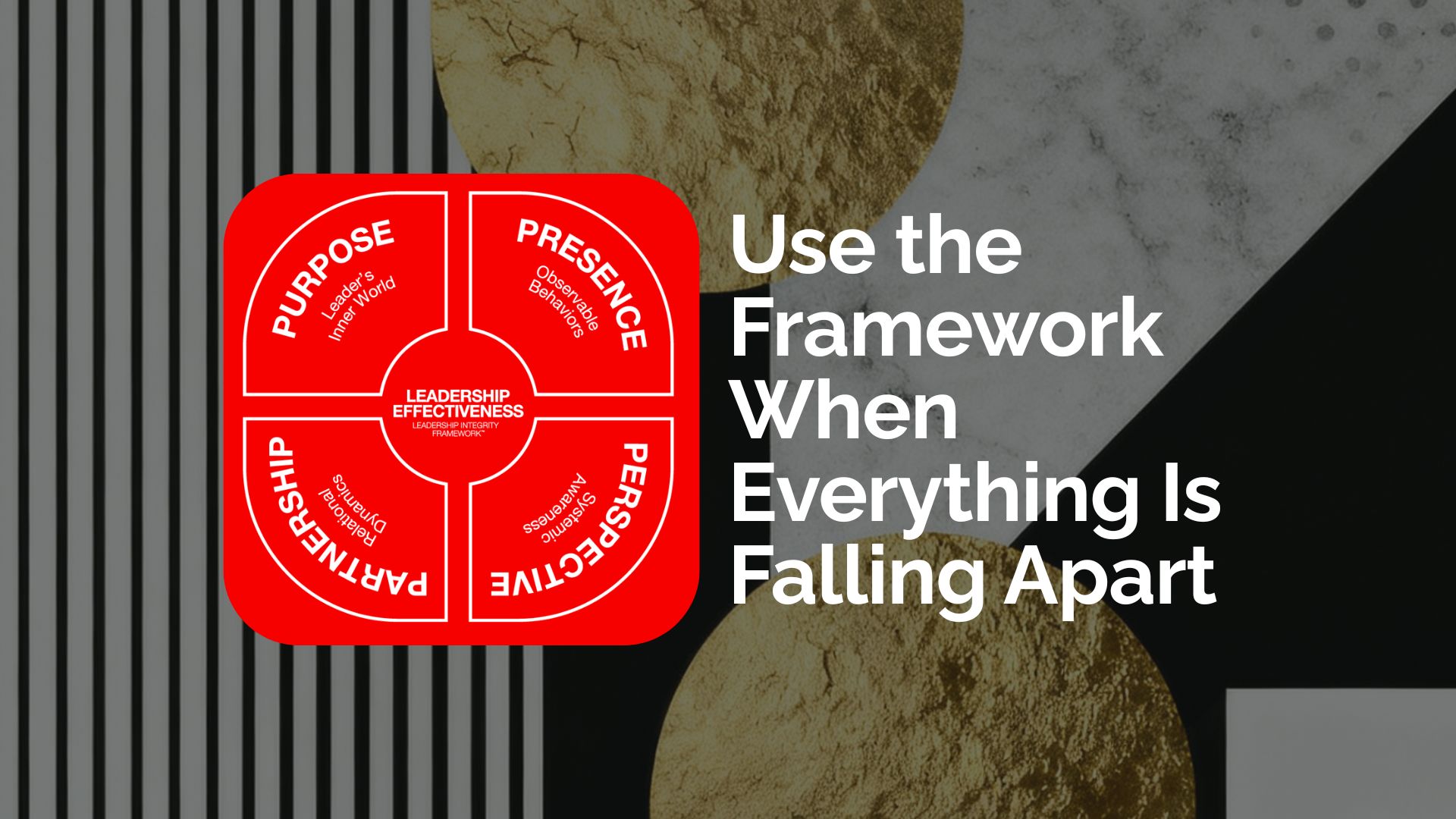
The Leadership Integrity Framework was never designed for calm conditions. It was built for exactly this: decision-making under pressure, when your nervous system is lit up and your usual clarity feels far away.

The framework won’t make things less complex. But it can help you stay coherent inside it. And when everything feels like it’s falling apart, coherence may be the only thing you can actually choose.

Why Most Frameworks Fail Under Pressure

There’s one thing no one tells you about leadership during crisis: under stress, you don’t rise to the level of your training. You fall to the level of your deepest patterns. I’ve watched it happen with hundreds of leaders. The ones who are most disciplined in calm conditions are often the most surprised by what surfaces when the pressure is real.

That brilliant strategy you mapped out in last quarter’s offsite? It evaporates as soon as cortisol floods your system. The communication principles from that executive development program? They vanish the moment your amygdala decides this is a threat.

This is the gap most leadership frameworks can’t bridge. They assume rational processing when your brain has already shifted into survival mode. They were designed for the version of you that has time to think, not the version running on three hours of sleep with the board calling in the morning.

That’s not a personal failure. It’s neuroscience. When stress escalates, the prefrontal cortex, the part of your brain central to complex reasoning and judgment, starts losing ground to faster, threat-sensitive systems that bias you toward fight, flight, or freeze-type responses.

What no leader needs in that moment is another model to remember. What they need is a way to find their footing when every instinct says “react now.”

The Leadership Integrity Framework doesn’t pretend to solve your crisis. It stabilizes you inside it. And in my experience coaching senior executives through moments like these, the quality of a leader’s decisions under pressure has less to do with their strategy and more to do with whether they can find their center before they act.

The way it works under pressure is through four questions. Not sequential steps. Not a checklist. Four anchors, each tied to a dimension of the framework, that help you locate yourself when the ground shifts.

Let me show you what I mean.

When Purpose Wavers: Grounding Leadership During Crisis

“Who am I in this situation?”

It sounds like a simple question. It’s not. Because when pressure peaks, the first thing to fracture is your connection to yourself.

A senior vice president I coached had spent four months doing everything right. He’d initiated succession planning early, identified a strong internal candidate, and was preparing to transition into a new role. The handoff was on track. The team was adjusting. He was already thinking about what came next.

Then, one month before his move, the news arrived: his successor had accepted an offer from another organization.

In the span of one phone call, four months of careful planning collapsed. And his first instinct wasn’t strategic. It was personal. He felt exposed. What would the board think about his judgment? Had he missed something in the candidate? Was this a reflection of his leadership, his team, the culture he’d built?

That’s what crisis does to Purpose. It hijacks the question from “What matters here?” to “What does this say about me?” Fear takes the wheel. Approval-seeking disguises itself as accountability. Risk avoidance masquerades as prudence. And before you know it, you’re making choices that belong to someone else’s leadership, not yours.

The practice is deceptively simple. Before the emergency call, before the crisis meeting, before the next decision, pause. One breath. And ask: What do I actually believe about this?

Not what’s expected. Not what’s expedient. What do you believe?

For this leader, the answer came slowly. He believed that leadership continuity mattered more than his personal timeline. He believed the organization had more depth than one candidate. And he believed that how he handled this moment would teach his team more about leadership than any transition plan ever could.

That clarity didn’t fix the problem. But it meant the person solving it was actually him.

When Presence Fractures: Centering Yourself for Decision-Making Under Pressure

“How do I want to show up right now?”

Once he found his grounding in Purpose, the next challenge surfaced quickly. He knew what he believed. But knowing and embodying are different things.

In the days after the news broke, he did what most capable leaders do under pressure: he moved faster. More meetings. Shorter conversations. Quicker decisions. He told himself he was being decisive. What his team experienced was something else entirely.

His chief of staff finally said it to him directly: “You’re not listening to anyone right now. You’re just moving.”

That feedback stung because it was precise. He had been so focused on solving the problem that he hadn’t noticed what his urgency was communicating. Every clipped response, every meeting cut short, every rapid-fire directive was sending the same signal: something is very wrong, and I don’t trust us to handle it together.

Fracturing Presence rarely looks like a dramatic breakdown. More often it’s subtler: a shift in pace, a tightness in tone, a quality of attention that narrows instead of holds. Your team reads these signals faster than you think. They adjust to your energy before they respond to your words.

The practice I teach is what I call the “micro-pause.” Three breaths before you enter the room, join the call, or hit send. Not meditation. Not a wellness ritual. Just three conscious breaths that create a sliver of space between your stress and your response.

For this leader, the shift came when he walked into the next team meeting and, instead of opening with his plan, opened with honesty. “I’ve been moving fast because I’m worried. That’s not the energy this room needs from me right now.”

The room exhaled. And for the first time in a week, the conversation became productive.

When Partnership Breaks: Leading Through Uncertainty Together

“What are we building together?”

Crisis has a way of shrinking your world. When everything is urgent, the instinct is to consolidate control. Fewer people in the room, faster decisions, less debate. It feels efficient. It feels decisive.

For this leader, the instinct kicked in hard. Within 48 hours of losing his successor, he had drafted a revised transition plan with two trusted advisors. He was ready to present it to the board as a done deal.

His coach (me) asked one question: “Who on your team knows they’re part of this plan?”

Silence.

He had built a solution without involving the people who would have to live inside it. His leadership team, several of whom had been deeply invested in the original transition, had no idea the plan had already been rewritten. Two of them, he later admitted, might have been viable succession candidates themselves.

Partnership doesn’t usually fracture through malice or neglect. It fractures through speed. The leader moves so fast that collaboration becomes an afterthought. And in that narrowing, you lose the very perspectives you need the most.

The practice is a question asked before any major crisis decision: Who needs to be in this conversation? Whose perspective am I missing?

When he brought his leadership team into the conversation, not to inform them of his plan but to think with them, two things happened that he hadn’t anticipated. A director he’d overlooked raised her hand as a potential interim successor. And the team surfaced concerns about the original transition timeline that they’d been holding back for weeks.

The best answer was already in the room. He just hadn’t opened the door.

When Perspective Fails: Regaining Clarity Inside Complexity

“What am I not seeing?”

This is perhaps the hardest question to ask when you’re deep inside a crisis, because urgency narrows your field of vision by design. Your brain locks onto the immediate threat. You solve the problem right in front of you. And that intensity can blind you to the patterns operating underneath.

For weeks, he had been treating the succession crisis as a problem to replace: find another candidate, adjust the timeline, keep the transition alive. Every conversation was about who and when. Reasonable questions. But they were keeping him on the surface.

In a coaching session, I asked: “Forget the replacement for a moment. What does it mean that your strongest internal candidate chose to leave?”

He didn’t answer right away. When he did, what came out surprised both of us.

The successor hadn’t left because of a better offer, not really. She’d left because the role she was inheriting had been shaped by years of organizational habits that no longer served the business. The scope was unclear. The reporting lines were tangled. Two of the key relationships the role depended on had been strained for over a year and no one had addressed them. She’d seen all of this during the transition planning and quietly concluded it wasn’t fixable from inside.

He had been so focused on the handoff that he’d missed what his successor had seen clearly: the role itself needed to be redesigned before anyone could succeed in it.

Perspective in a crisis means lifting your head just enough to ask: What problem am I actually solving? Is it the right one? Sometimes the fire you’re fighting is pointing you toward something you’ve been avoiding. This leader’s succession crisis turned out to be a role design problem that had been sitting in plain sight for over a year.

What the Four Questions Make Possible

He didn’t find a successor that week. The transition timeline shifted. The original plan didn’t survive the crisis. But something more important did: his capacity to lead through it with coherence instead of reactivity.

The four questions aren’t sequential steps. They’re anchors. In any given crisis, you might need one more than the others.

“Who am I in this situation?” grounds you when fear starts driving.

“How do I want to show up?” steadies you when urgency takes over.

“What are we building together?” reconnects you when speed narrows the circle.

“What am I not seeing?” opens the aperture when you’re locked on the wrong problem.

The framework doesn’t eliminate complexity. It helps you stay whole inside it, so the decisions you make under pressure are ones you can stand behind when the pressure lifts.

If you’re navigating complexity right now and want to go deeper, the book Leadership Integrity: How to Stay Grounded, Build Trust, and Lead with Wholeness in Uncertain Times offers extended case studies of leaders who used these practices through sustained periods of pressure and uncertainty.

If you’re curious about what happened on my side of the coaching conversation during this leader’s crisis, I wrote about that here.

And if you’re looking for a community of senior leaders doing this work together, join us. Because leadership in crisis was never meant to be held alone.

Further Reading, If This Resonates

If you’ve ever felt that “being authentic” still isn’t quite enough for the role you’re in, you’re not alone. Here are a few places you might enjoy exploring next.

On authentic leadership’s promise and limits

Bill George’s work on authentic leadership helped many leaders reclaim values, purpose, and voice at work. More recent critiques—from writers like Tomas Chamorro-Premuzic and scholars such as Donna Ladkin and colleagues—explore where “being true to myself” can backfire or exclude context and power. Together, they offer a fuller picture of when authenticity helps and when it can get in the way.

On integrity as alignment, not perfection

Leaders and thinkers writing about integrity—such as L. Christian Duperouzel and various conscious leadership practitioners—often frame it as alignment between inner standards, outward behaviour, and the systems you shape, rather than as moral perfection. Their work can be useful if you’re looking for language that connects personal wholeness with organizational impact.

On vertical development and growing your capacity

Robert Kegan, Jennifer Garvey Berger, and practitioners like Nick Petrie and the Center for Creative Leadership have brought vertical development into the leadership conversation—how leaders grow their capacity to hold multiple perspectives, navigate complexity, and stay grounded under pressure. If you’re wondering how Purpose, Presence, Partnership, and Perspective expand over time—not as competencies, but as ways of seeing—this strand of work is a rich companion.

None of these are prerequisites for leading with integrity. But if you’re drawn to the deeper architecture behind authenticity, trust, and effectiveness, they can offer a helpful backdrop as you experiment with your own leadership.

And if you’d like to keep exploring through the lens of the Leadership Integrity Framework—Purpose, Presence, Partnership, and Perspective—you’re very welcome to stay connected.

Take the Next Step

Discover Your Leadership Signature

Not sure where to start? The LīF Assessment helps you identify which dimension is your natural strength right now.

Explore the Leadership Integrity Framework

Want to understand the four dimensions before you dive into the book? Start with the framework overview.

>