The Leadership Blindspot That‘s Harder to See Than You Think

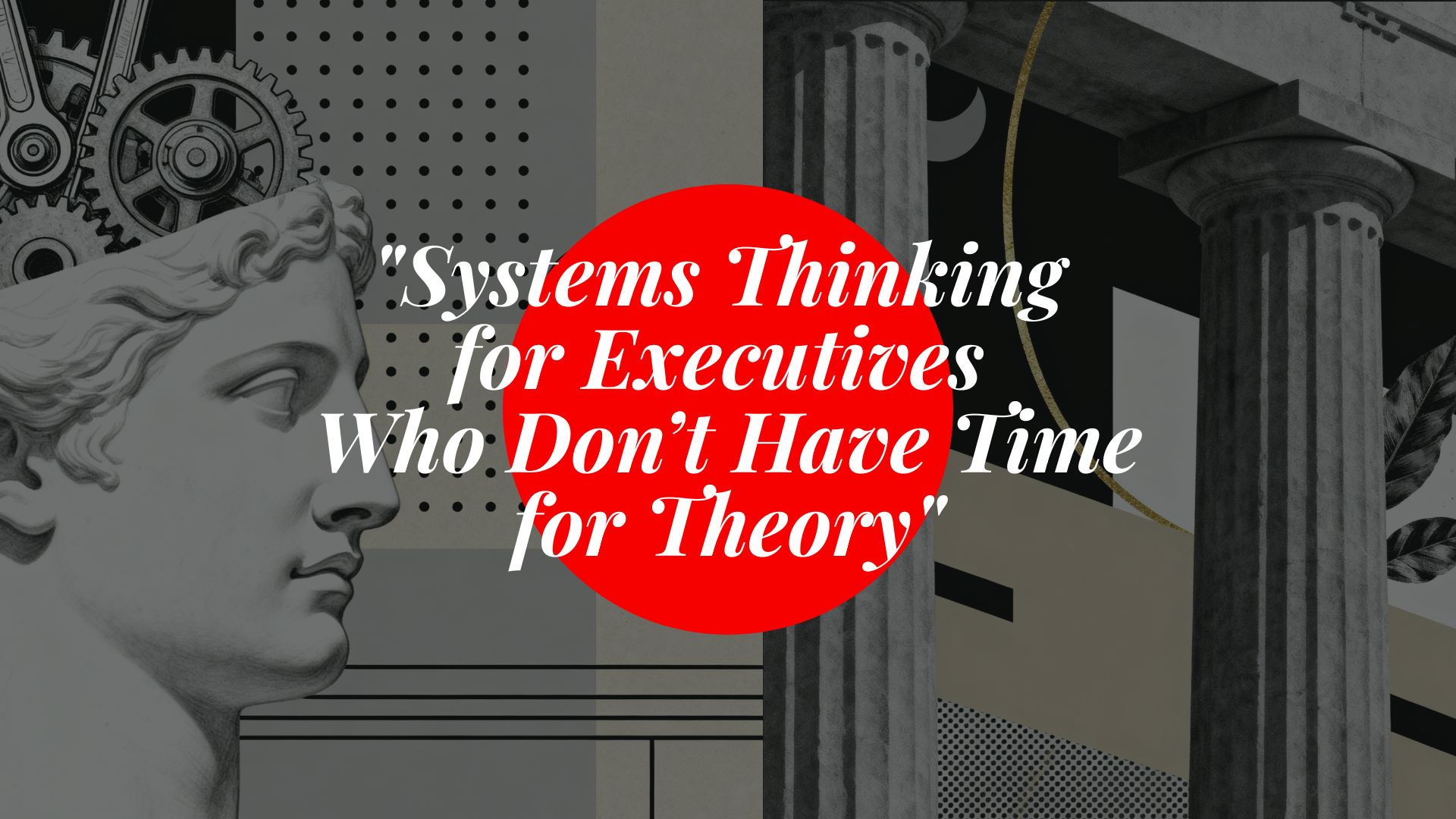
Systems Thinking for Executives Who Don’t Have Time for Theory

You can’t see the system you’re swimming in. Until something breaks.

I watched this play out with a Fortune 500 executive last year. Every quarter, same pattern: aggressive growth targets, heroic individual efforts, last-minute scrambles to hit numbers, team burnout, then more aggressive targets to compensate. Rinse and repeat.

He was brilliant at solving each crisis as it emerged. Expert at motivating his team through the chaos. Masterful at explaining to leadership why the pattern kept happening—market conditions, resource constraints, timing issues.

What he couldn’t see was that he wasn’t solving problems. He was perpetuating a system that guaranteed the problems would keep coming back, bigger and more complex each time.

This is the leadership blindspot that’s hardest to detect because it requires stepping outside your own experience to see it. Most of what we call “strategic thinking” is actually tactical thinking done faster. Real systems thinking for leaders means recognizing the patterns you’re caught in and learning to design for different outcomes.

And right now, with AI disrupting industries overnight and complexity increasing faster than our management models can adapt, this might be the most critical leadership capability of all.

Why Leaders Struggle with Systems Thinking

There’s something telling in the search data around systems thinking. Most queries are “what is” questions rather than “how to” questions. Leaders sense they need this capability but can’t quite grasp how to develop it.

The challenge isn’t intelligence. It’s that we’re trained for linear cause-and-effect thinking in a world of circular feedback loops. We look for the root cause when there are multiple interacting causes. We solve the symptom when the real issue is structural. We optimize the part while degrading the whole.

The stakes are higher now than they’ve ever been. Market volatility, technological disruption, shifting workforce expectations, supply chain complexity. The old playbook of “identify problem, apply solution” breaks down when the problems are emergent properties of the system rather than isolated incidents.

Ron, one of the leaders I write about in the book, experienced this firsthand when he stepped into a General Manager role. “I know how to lead a team,” he told me. “But how do I lead a system?” As an operations expert, he was brilliant at solving problems as they emerged. But the new role required him to see patterns, anticipate leverage points, and influence outcomes at levels of complexity he’d never navigated before.

Research in neuroscience suggests that some leaders develop systems thinking more naturally than others, which may be related to how their default mode network (the brain’s background processor) makes connections across seemingly unrelated domains. But this isn’t a fixed trait. It’s a muscle that can be strengthened through practice.

The question is: what kind of practice actually works?

What Perspective Actually Includes

In the Leadership Integrity Framework, Perspective isn’t about predicting the future. It’s about seeing the present more clearly. It’s the dimension where Purpose, Presence, and Partnership come together to create strategic wisdom.

Vision means imagining futures worth building together, not just forecasting what’s likely to happen. It’s the capacity to see possibilities that don’t yet exist and help others understand why they matter.

Influence is helping others see what’s possible, creating shared sight lines toward outcomes that serve everyone. This goes beyond persuasion to genuine co-creation of understanding.

Systems Thinking means seeing loops, not just lines. Recognizing that in complex systems, effects become causes, solutions create new problems, and the most effective interventions often happen far from where the symptoms appear.

Sustainability involves designing for what lasts, not just what works in the short term. This includes environmental sustainability but extends to sustainable business models, sustainable team dynamics, sustainable growth patterns.

Decision-Making aligns consequence and conscience, considering both immediate outcomes and long-term implications, both quantitative results and qualitative impacts.

Ethics provides moral clarity in complex choices where there are no perfect answers, only better and worse ways of navigating trade-offs.

Adaptability means staying responsive as conditions shift without losing coherence about what matters most.

These elements work together differently than the previous dimensions. There are dozens of frameworks promising systems thinking mastery—the 5 C’s, the 7 skills, the 4 A’s of adaptive leadership. Each captures something true, but Perspective isn’t about mastering components. It’s about integrating them into a way of seeing that becomes second nature.

Strategic thinking isn’t a long-term process separate from daily operations. It’s seeing today’s decisions through tomorrow’s lens, recognizing that every choice you make is shaping the system you’ll be operating in next year.

How to Develop Perspective in Practice

The development of systems thinking for executives starts with learning to zoom out, but not in the way most leadership development teaches it.

Ron’s breakthrough came when he stopped trying to predict what would happen and started mapping what was happening. During a challenging quarter, instead of jumping into crisis mode, he stepped back and mapped the system. Not an org chart, but flows: Who influences what? Where does energy go? What keeps getting stuck?

As he worked through the map, patterns emerged. The bottlenecks weren’t random events requiring heroic intervention. They were predictable outcomes of competing priorities. The endless approval loops weren’t bureaucratic spite; they were safety mechanisms from teams afraid to make the wrong call.

“It wasn’t personal. It wasn’t chaos,” he reflected. “It was a system doing exactly what it was designed to do, even if that design no longer served anyone well.”

This shift from “fixing problems” to “understanding patterns” is the foundation of strategic leadership. Instead of asking “How do I solve this?” Ron learned to ask “What am I not seeing?” and “What becomes possible if we design this differently?”

The practice extends into how you approach influence and decision-making. When Ron started sharing insights from his operational background in strategic conversations, something shifted. Instead of just reporting up, he began contributing perspective that helped senior leadership make better decisions.

As I’ve explored before about the relationship between humility and learning, the most effective systems thinkers maintain what researchers call “epistemic humility”—confidence in their ability to learn combined with awareness of what they don’t yet know.

The practice of owning your expertise while remaining open to new information becomes crucial when you’re trying to influence complex systems. You need enough conviction to act and enough flexibility to adapt when the system responds in unexpected ways.

Ron’s development included learning to ask different questions in meetings: “What cultural implications should we consider with this expansion?” instead of just focusing on technical execution. When the CEO heard this question, he stopped the conversation: “That’s the question we should have started with. Technical execution without cultural cohesion would undermine everything else we’re trying to build.”

This isn’t philosophical. It’s survival-level practical. Leaders who can’t think systemically get trapped in reactive cycles that exhaust their teams and limit their effectiveness.

What Perspective Looks Like When It Works

Six months into Ron’s transformation from operations expert to enterprise leader, the integration of all four dimensions became visible in how he approached a supply chain crisis.

Instead of just solving the immediate problem, Ron saw connections others missed. His region had solved a similar challenge using a different approach. He reached out to the European division’s GM to share insights, which led not just to immediate help but to a broader conversation about knowledge-sharing across the organization.

The CEO asked Ron to lead a cross-divisional task force on operational excellence. This was Perspective enabling influence at the enterprise level. Ron wasn’t just managing his piece of the system anymore; he was helping design how the whole system could learn and adapt.

“I want to create a forum where operational leaders can share not just best practices, but the thinking behind them,” Ron explained. “The ‘why’ not just the ‘what.’ I think there’s huge untapped value in connecting the dots between what’s working in different contexts.”

This illustrates how Vision and Systems Thinking work together. Ron could see a possibility for organizational learning that didn’t yet exist and help others understand why it mattered. His approach balanced immediate value with sustainable capability building.

The business outcomes were measurable: faster problem-solving across divisions, reduced duplicate efforts, innovation through cross-pollination of ideas. But more importantly, Ron had shifted from being someone who implemented strategy to someone who influenced how strategy emerged from collective intelligence.

“I stopped thinking about my operational background as something to overcome and started seeing it as my unique contribution,” he reflected. “Once I understood that, everything else followed—the confidence, the influence, the ability to think systemically.”

The Integration of All Four Dimensions

The question that guides this dimension is: “What am I not seeing?”

But here’s the crucial insight: you can’t develop Perspective in isolation from the other dimensions. Without Purpose, systems thinking becomes academic exercise. Without Presence, strategic insight remains private intelligence. Without Partnership, even a brilliant perspective can’t create change because people don’t trust the source.

This is why I’ve structured this blog series the way I have. As I explored in the framework introduction, Purpose provides the internal foundation. Presence makes it visible and trustworthy. Partnership creates the relational field where insights can be shared and tested. Perspective integrates all three to create strategic wisdom.

Ron’s final reflection captures this integration: “The framework we used has become second nature now. When I’m facing a challenge, I naturally check in with what really matters to me, how I want to show up, what relationships I need to strengthen, and what I might be missing in the bigger picture. It’s like having an internal compass.”

This is how leadership integrity actually works in practice. Not as separate competencies to master but as an integrated way of being that becomes increasingly natural with practice.

The most strategic leaders aren’t those who can predict the future most accurately. They’re those who can navigate complexity with wisdom, who can hold multiple perspectives simultaneously, who can influence systems while remaining true to their values.

The Practice Continues

This concludes our exploration of the four dimensions, but the real work is just beginning. The Leadership Integrity Framework isn’t something you learn and then apply. It’s something you live and continue developing throughout your leadership journey.

The full framework, with complete case studies showing how leaders like Ron, Sarah, and Dina integrated all four dimensions to transform their effectiveness, is explored in Leadership Integrity: How to Stay Grounded, Build Trust, and Lead with Wholeness in Uncertain Times.

Want to discover where your natural leadership strength currently lies? The Leadership Signature Discovery reveals which dimension serves as your foundation right now. This assessment helps you understand not just your current signature strength but how to build integration across all four areas over time.

If this approach to integrated leadership resonates with you, I invite you to join our community. We share thoughtful reflections on leadership integrity—meaningful communication, not inbox clutter.

The world needs leaders who can navigate complexity with wisdom, who can hold paradox without collapsing into simple answers, who can influence systems while remaining grounded in their humanity. This work—developing Purpose, Presence, Partnership, and Perspective as an integrated whole—is how we get there.

Further Reading, If This Resonates

If you find yourself curious about the ideas underneath this story—systems thinking, epistemic humility, and how leaders develop strategic perspective—here are a few places to explore next.

On systems thinking and complexity

Peter Senge’s work on learning organizations and systems thinking offers foundational insight into how leaders can see patterns, leverage points, and circular causality rather than linear problems. His writing is particularly useful if you’re wrestling with challenges that keep recurring despite your best efforts to solve them. Donella Meadows’ work on systems thinking and leverage points provides accessible entry into understanding how small shifts in complex systems can create disproportionate impact.

On the default mode network and creative thinking

Recent neuroscience research on the brain’s default mode network reveals how our minds make connections across seemingly unrelated domains—a core capability for systems thinking. This body of work helps explain why some of our best strategic insights emerge during reflection rather than in the midst of problem-solving.

On epistemic humility and leadership

Research on epistemic humility—the capacity to hold confidence in your ability to learn alongside awareness of what you don’t yet know—shows why the most effective systems thinkers remain open to being wrong. This isn’t about lacking conviction; it’s about maintaining the flexibility to adapt when the system responds in unexpected ways.

On adult development and perspective-taking

Robert Kegan’s work on adult development and constructive-developmental theory explores how leaders grow in their capacity to hold complexity, see multiple perspectives simultaneously, and integrate seemingly contradictory information. This research illuminates why some leaders naturally think more systemically and how this capability can be developed over time.

On strategic thinking vs. tactical execution

The distinction between strategic and tactical thinking isn’t just about timeframes; it’s about the quality of attention leaders bring to decisions. Resources on strategic leadership explore how to develop the capacity to see today’s choices through tomorrow’s lens and recognize when you’re optimizing parts at the expense of the whole.

None of these are prerequisites for leading well. But if you’re drawn to understanding how perspective develops, how systems reveal themselves, and how strategic wisdom emerges through practice, they can offer a rich foundation as you experiment with your own leadership.

And if you’d like to keep exploring these questions through the lens of the Leadership Integrity Framework—Purpose, Presence, Partnership, and Perspective—you’re welcome to stay connected.

The practice continues.

Take the Next Step

Discover Your Leadership Signature

Not sure where to start? The LīF Assessment helps you identify which dimension is your natural strength right now.

Explore the Leadership Integrity Framework

Want to understand the four dimensions before you dive into the book? Start with the framework overview.

>