
The Leadership Integrity Framework℠

Four interconnected dimensions that help you lead from wholeness in complexity

Leadership integrity isn’t about mastering isolated skills. It’s about integration—bringing together your inner clarity, your outer expression, your relationships, and your systemic awareness into a coherent whole.
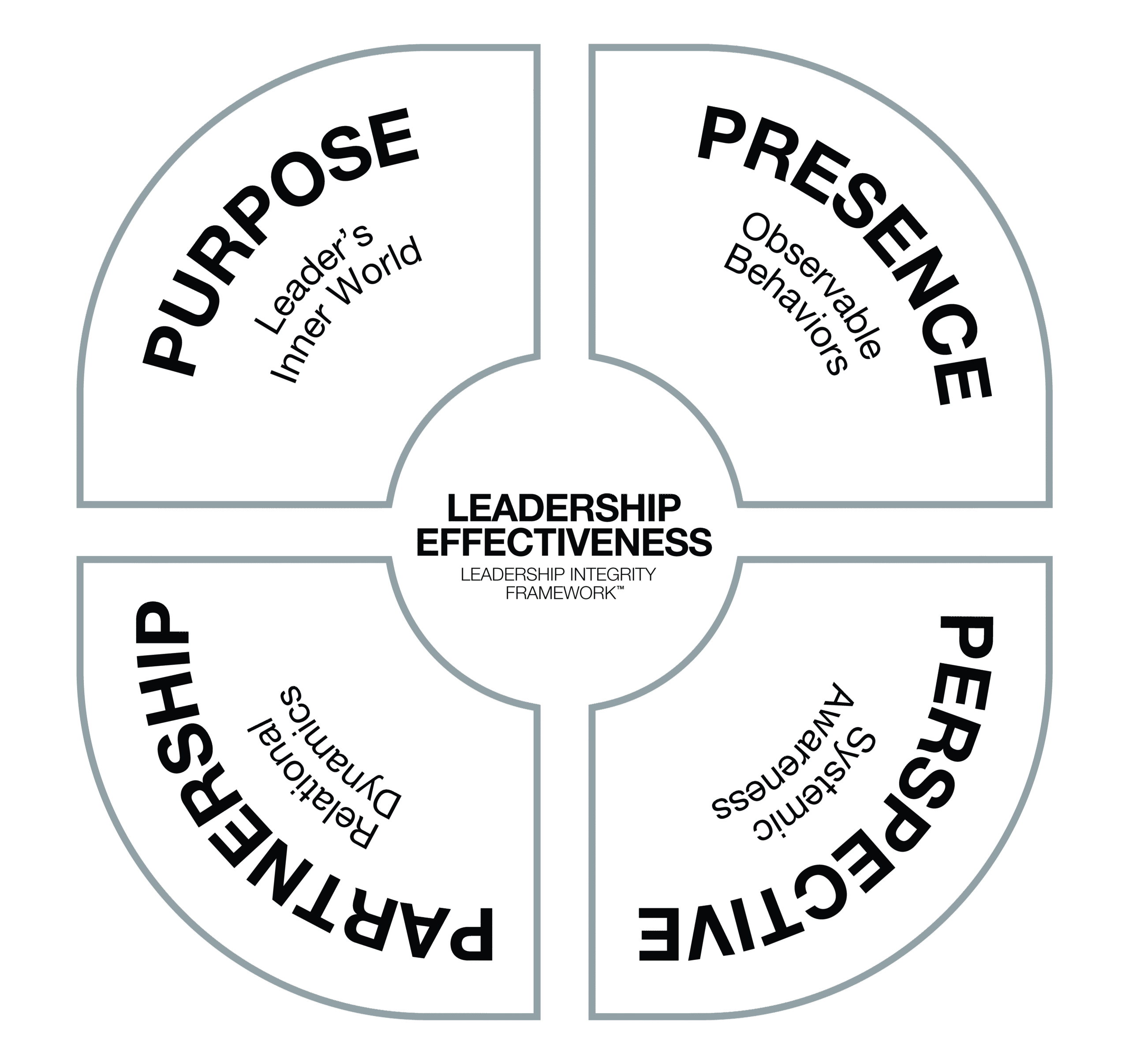
The Leadership Integrity Framework℠ maps this territory through four essential dimensions. Each one represents a vital aspect of leadership. Together, they create the foundation for leading with authenticity, effectiveness, and sustainability.
1
2
3
4
1

Purpose is your internal compass—the clarity about your values, beliefs, and motivations that anchors your leadership when everything else is uncertain. Without it, even the most skilled leaders drift, performing roles instead of living values.

2

Presence is where your internal alignment becomes observable. It’s the bridge between who you are and how others experience you. People sense your emotional state before you finish your first sentence—calm or anxious, grounded or scattered, authentic or performed.

3

Leadership doesn’t happen in isolation. It lives in the space between people—in the quality of connection, the depth of trust, the willingness to engage authentically even when it’s difficult. Without partnership, even brilliant strategies fail because teams comply but don’t commit.

4

Leadership in complexity requires the capacity to zoom out—to see patterns, connections, and consequences beyond the immediate. Perspective helps you make decisions that serve not just today’s pressures, but tomorrow’s possibilities. Without it, even capable leaders get trapped solving the same problems repeatedly.


The Inner World of Leadership

The Core Question: Who am I? What drives me?

Why It Matters

Purpose is your internal compass—the clarity about your values, beliefs, and motivations that anchors your leadership when everything else is uncertain. Without it, even the most skilled leaders drift, performing roles instead of living values.

The Seven Elements

  • Mindset
  • Self-Awareness
  • Values and Drive
  • Reflection
  • Resilience
  • Leadership Philosophy

In Practice

When Sofia stepped into her global leadership role, she brought impressive credentials and a track record of results. But six months in, something felt off. She was over-preparing for every meeting, second-guessing her instincts, and feeling invisible despite her expertise.

The breakthrough came when she stopped trying to prove she belonged and started trusting that she did. By reconnecting with what actually drove her—not external validation, but meaningful contribution—her entire presence shifted. The room could feel the difference.

What shifts when Purpose is clear: You make decisions aligned with your values, even under pressure. You stay grounded through ambiguity. Leadership feels like authentic expression, not performance.

What happens when Purpose drifts: You’re delivering results but questioning why. Success feels hollow. You’re constantly auditioning for your own job.

[Explore Purpose in depth in Chapter 3 →]

How You Show Up When It Matters

The Core Question: How do I show up?

Why It Matters

Presence is where your internal alignment becomes observable. It’s the bridge between who you are and how others experience you. People sense your emotional state before you finish your first sentence—calm or anxious, grounded or scattered, authentic or performed.

The Seven Elements

  • Impact Awareness
  • Values in Action
  • Reliability
  • Composure
  • Authenticity
  • Feedback Integration
  • Reputation

In Practice

Daniel was known for his operational excellence and steady demeanor. After a merger, he tried to adapt by staying quiet in meetings, carefully managing what he said to avoid seeming like he wasn’t “getting with the program.”

His team noticed. “You don’t seem like yourself,” a trusted colleague said. “You’re quieter. I don’t know where you stand anymore.”

Daniel realized he wasn’t being strategic by hiding his values—he was becoming invisible. When he started letting his principles guide his contributions again (even within the new constraints), something shifted. His influence returned, not through volume, but through the reliability of his character.

What shifts when Presence is aligned: You create psychological safety through steady engagement. Others trust you because your actions match your words. You stay centered under pressure.

What happens when Presence falters: Stress becomes contagious. Your message gets lost in your delivery. The gap between intention and perception grows.

[Explore Presence in depth in Chapter 4 →]

How You Show Up When It Matters

The Core Question: What are we building together?

Why It Matters

Leadership doesn’t happen in isolation. It lives in the space between people—in the quality of connection, the depth of trust, the willingness to engage authentically even when it’s difficult. Without partnership, even brilliant strategies fail because teams comply but don’t commit.

The Seven Elements

  • Emotional Intelligence
  • Trust
  • Communication
  • Conflict Resolution
  • Relationships
  • Accountability
  • Team Cohesion

In Practice

Lena sat in the crisis meeting watching the leadership team debate damage control for a viral video about discrimination at the company. She had thoughts—important ones—but she froze, caught between speaking truth and protecting her position as one of the few women of color in the room.

Later, instead of staying silent, she did something different. She proposed a restorative town hall. Not to assign blame or spin the narrative, but to actually listen and rebuild trust. It was uncomfortable. Not everyone welcomed it. But the conversation shifted from crisis management to genuine accountability.

What shifts when Partnership thrives: Trust enables honest conversations. Conflict deepens rather than damages relationships. People contribute their full selves, not just their compliance.

What happens when Partnership breaks down: Relationships become transactional. Unspoken tensions block progress. Leadership feels lonely even when surrounded by people.

[Explore Partnership in depth in Chapter 5 →]

Leading with Systems Awareness

The Core Question: What am I not seeing?

Why It Matters

Leadership in complexity requires the capacity to zoom out—to see patterns, connections, and consequences beyond the immediate. Perspective helps you make decisions that serve not just today’s pressures, but tomorrow’s possibilities. Without it, even capable leaders get trapped solving the same problems repeatedly.

The Seven Elements

  • Vision
  • Influence
  • Systems Thinking
  • Sustainability
  • Decision-Making
  • Ethics
  • Adaptability

In Practice

Ron had been promoted to General Manager with expanded regional responsibility, but he kept getting stuck in execution mode. He’d show up to strategic meetings with detailed operational answers when what the CEO really needed was someone who could see the bigger picture.

The shift happened when Ron stopped defending his approach and started asking different questions: “What patterns are we seeing across regions? What might we be missing about our customers’ changing needs?” He wasn’t abandoning his operational expertise—he was applying it at a different altitude.

What shifts when Perspective expands: You see leverage points others miss. You adapt without losing your center. Decisions serve both immediate needs and long-term health of the system.

What happens when Perspective narrows: You’re constantly firefighting. You solve symptoms while missing root causes. You optimize your piece while the whole deteriorates.

[Explore Perspective in depth in Chapter 6 →]

How the Framework Works

Integration, Not Isolation

The power of this framework doesn’t live in mastering individual dimensions. It emerges from their integration—how they reinforce and strengthen each other over time.
Purpose without Presence remains private wisdom that never influences others.
Presence without Partnership becomes performance without genuine connection.
Partnership without Perspective creates strong relationships that may be optimizing the wrong things.
Perspective without Purpose offers strategic insight without the grounding to act on it.
When all four dimensions develop together, leadership stops feeling fragmented. Decisions become clearer. Relationships deepen. Impact expands.

Your Starting Point

You don’t need to develop all four dimensions simultaneously. Start where you are:

  • Which dimension creates the most recognition when you read about it?
  • Where have you received consistent feedback pointing to a growth edge?
  • What aspect of your leadership feels most out of alignment right now?

Growth in one area naturally creates possibilities in others.

See the Framework in Action

The framework comes alive through practice, not theory. In the book, you’ll meet Sarah, Ron, and Dina—three leaders whose complete journeys show how the dimensions work together in real leadership challenges.

Their stories aren’t about perfect implementation. They’re about real leaders using the framework to navigate complexity, make wiser choices, and lead with greater wholeness.

Next Steps

Take the LīF Assessment

Understand Your Signature Strength to discover which dimension is your leadership signature strenth right now.

Go
Deeper

Read the book for comprehensive exploration of each dimension, complete with leadership stories, reflection practices, and practical guidance.

Ready for coaching?

Get Personalized Support. Explore options for applying the framework to your specific context and challenges.

>