• The Question Senior Leaders Avoid Asking

The Question Senior Leaders Avoid Asking (And Why It’s Costing You More Than You Think)

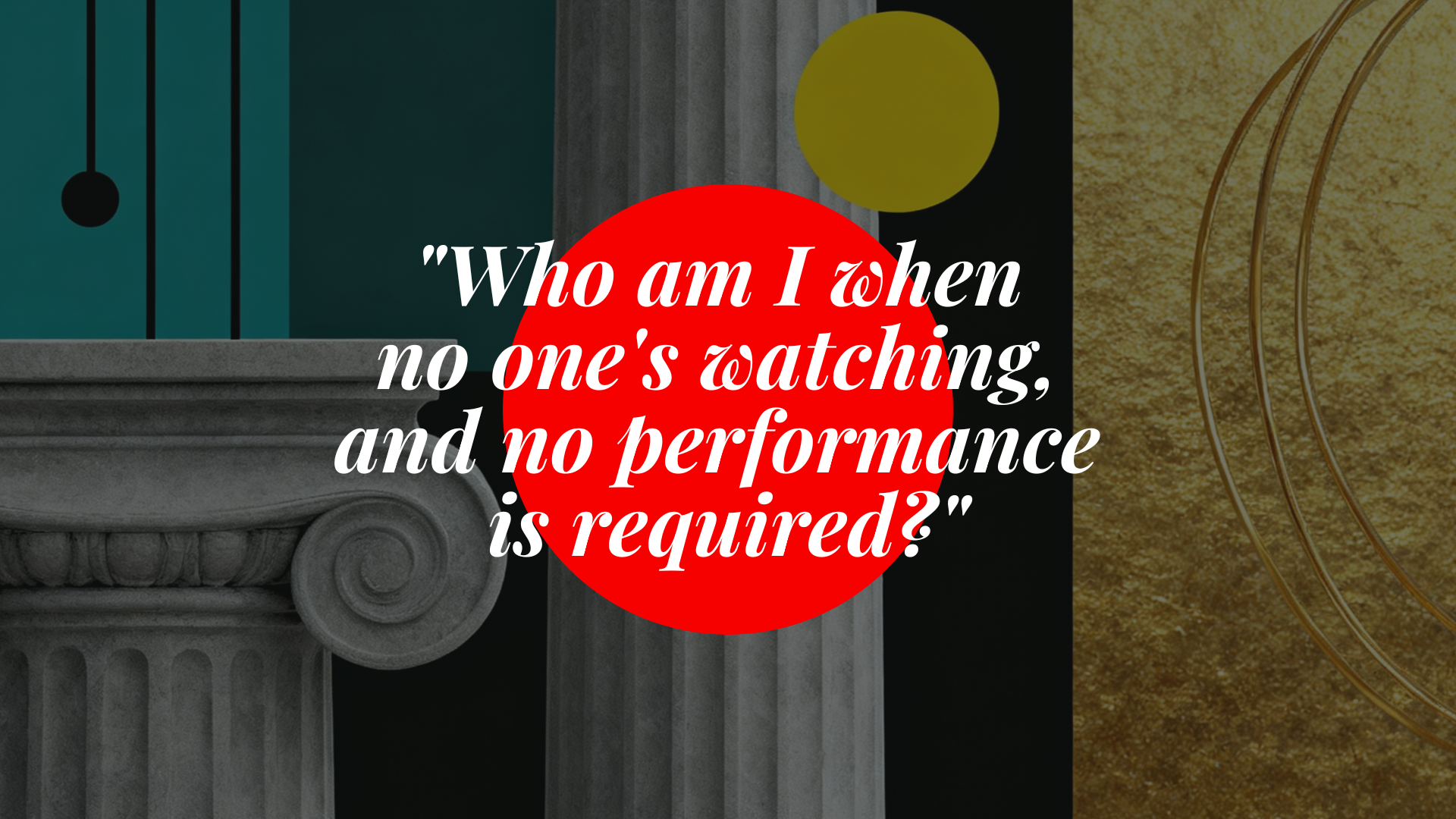
“Who am I when no one’s watching and no performance is required?”

I asked this question during a leadership retreat with six C-suite executives. The room went silent. Not the comfortable kind of silence that settles when people are thinking deeply, but the restless kind that happens when a question hits something tender.

Finally, one of the leaders—someone I’d watched command boardrooms with masterful presence—said quietly, “I honestly don’t know. I know who I am in the office, who I am in strategy sessions, who I am when investors are watching. But who I am when all of that falls away?” He paused. “I’m not sure I’ve thought about that in years.”

He wasn’t alone. The nods around the room told the story I’d been seeing in coaching session after coaching session: brilliant leaders who had become virtuoso performers, but somewhere along the way had lost touch with the person doing the performing.

This isn’t a leadership skills gap. It’s something deeper. When the inner foundation of leadership goes unattended, everything else becomes performance. And performance, no matter how polished, eventually exhausts both the leader and everyone around them.

In the Leadership Integrity Framework, I call this inner foundation Purpose. Not your mission statement or your motivational “why,” but the deeper dimension that includes your mindset, self-awareness, values, resilience, and capacity for reflection working together as a coherent whole.

The Performance Trap

Here’s what happens when leaders lose touch with their inner compass: they start borrowing clarity from external sources. The organizational vision becomes their vision. Their stakeholders’ priorities become their priorities. Industry best practices become their values. And it works—until it doesn’t.

Sofia, one of the leaders I write about in the book, discovered this during her transition to a global role. Everything looked right from the outside. She had the competence, the results, the team’s respect. But something felt off. Her calendar was full, her inbox overflowing, but she felt herself drifting. Her voice in meetings sounded practiced. Her camera smile became tight. As she described it to me: “I had answers to every question. Smart ones. Safe ones. But none of them felt like my own.”

This is what happens when we mistake professional competence for personal clarity. The work gets done, the results get delivered, but the leader slowly disappears behind their own performance.

Neuroscience tells us why this matters. Research suggests that when we operate primarily from external validation, we’re activating threat-detection and social-monitoring networks rather than creative problem-solving circuits. We’re scanning for cues about what’s expected (using more cognitive resources) rather than drawing from internally generated clarity (which flows more efficiently). It’s the cognitive equivalent of trying to navigate with someone else’s GPS while your own inner compass spins wildly.

The cost isn’t just personal exhaustion. When leaders operate from borrowed clarity, their teams feel it. Decisions feel hollow. Vision statements sound generic. The infectious energy that comes from authentic conviction gets replaced by the brittle enthusiasm of someone trying very hard to convince themselves.

What Purpose Actually Includes

What is reflective leadership? It’s the capacity to lead while simultaneously observing yourself leading. To notice your patterns, catch your triggers before they catch you, and choose responses instead of defaulting to reactions. Reflective leaders create space between stimulus and response—that’s where wisdom lives.

This brings us to the first dimension of the Leadership Integrity Framework: Purpose. As I explored in my introduction to the framework, this isn’t purpose in the traditional sense of mission statements or motivational mantras. This is Purpose as an integrated dimension of leadership—the inner foundation that everything else rests on.

Mindset is how you interpret challenge. Are setbacks evidence that you’re not cut out for this, or information about what needs to shift? Do you approach uncertainty as threat or territory to explore? This isn’t about positive thinking; it’s about the fundamental stories you tell yourself about what’s possible.

Self-awareness means knowing your patterns, triggers, and growth edges. It’s recognizing when you’re about to respond from defensiveness rather than curiosity, when your need to be right is overriding your ability to listen, when your strength is becoming your limitation.

Values and Drive get at what actually moves you, not what you think should move you. It’s the difference between leading from “I should care about this” and “I can’t not care about this.” Authentic drive has a quality of inevitability that manufactured motivation never quite achieves.

Reflection is the practice of making meaning from experience. It’s the capacity to step back from the swirl of daily demands and ask: What did I just learn? How did my assumptions hold up? What would I do differently? Without this practice, experience becomes just accumulated activity rather than accumulated wisdom.

Resilience isn’t about bouncing back unchanged. It’s about staying whole when familiar ground shifts beneath you. The kind of resilience that lets you adapt without losing yourself, that bends without breaking.

Leadership Philosophy is where these elements integrate into a coherent way of leading. Not a statement you frame and hang on the wall, but a living set of principles that guide you in the moments when there’s no playbook.

Most leadership frameworks treat these as separate competencies to develop. The integration message is this: they work together. Your values shape what you pay attention to in reflection. Your mindset influences how you interpret setbacks. Your self-awareness helps you stay resilient when pressure mounts.

The Path Back to Clarity

This integration work isn’t abstract. I think of Whitney, a regional president who came to coaching feeling what she called “competent but empty.” She could execute flawlessly, hit every metric, deliver in crisis situations. But when I asked her what energized her about the work, she went quiet.

“I used to know,” she said finally. “But somewhere in the last few years, I stopped asking myself that question.”

Whitney’s challenge wasn’t skills or strategy. It was that she’d become so focused on external performance that she’d lost touch with her internal compass. The breakthrough came when she committed to what we called “leadership archaeology”—deliberately excavating what had gotten buried under years of responding to other people’s priorities.

She started with simple reflection questions: When do I feel most alive in my leadership? What decisions am I most proud of, and what values were guiding me in those moments? When do I find myself going through the motions versus feeling genuinely engaged?

What emerged surprised her. Whitney realized that her most energizing moments weren’t the big strategic wins everyone celebrated. They were the smaller instances where she’d helped someone else see a possibility they couldn’t see before. Where she’d asked a question that shifted how her team thought about a challenge. Where she’d created space for someone to take a risk they weren’t sure they were ready for.

This is what executive self-awareness development actually looks like—not a workshop exercise, but a process of reconnecting with what genuinely motivates and drives you. Whitney wasn’t learning something new. She was remembering something true.

This awareness led to a shift in how she approached her role. Instead of measuring success purely through financial metrics, she began paying attention to what she called “development moments”—opportunities to grow others while advancing the business. Not because it was the right thing to do, but because it was what genuinely drove her.

Within six months, Whitney described feeling “awake again” in her leadership. Her team noticed the difference. Instead of managing them toward predetermined outcomes, she was engaging them in discovering what was possible. Her results improved, but more importantly, her leadership felt sustainable in a way it hadn’t for years.

The Practice of Inner Clarity

How do you develop this kind of integrated Purpose through intentional leadership practices? It’s not about weekend retreats or vision boarding (though those can help). It’s about building reflective leadership habits into the rhythm of your work.

Before important meetings, pause to ask: What do I hope to create here? Not just what outcomes do I want, but what quality of engagement, what kind of thinking, what depth of conversation?

When facing complex decisions, check in with your values: What would I choose if I only had to account to myself? What would I choose if this decision were going to be studied by future leaders? Where’s the tension between those two, and what does that tell me?

At the end of difficult days, practice meaning-making: What challenged my assumptions today? When did I feel most like myself? When did I feel like I was performing? What’s the difference?

This isn’t navel-gazing. It’s strategic clarity. I’ve written before about how confidence emerges from this kind of internal authority, and how owning your expertise requires first knowing what you actually believe. 

The research on neuroplasticity suggests that regular reflection literally rewires your brain, strengthening the neural pathways that support self-awareness and emotional regulation. Leaders who build this practice describe feeling more grounded under pressure, more creative in their problem-solving, more authentic in their relationships.

What This Enables

When Purpose is well-developed through these practices, you begin embodying what I call purpose-driven leadership—not leadership driven by external metrics or borrowed clarity, but leadership anchored in who you actually are. Everything else becomes more possible from that foundation. 

You can be present authentically because you know who you’re bringing to the room. You can build genuine partnerships because people sense they’re engaging with a real person, not a professional persona. You can think systemically because you have a stable internal reference point that lets you see beyond your immediate self-interest.

The core question that guides this dimension is: “What do I believe about this situation?” Not what am I supposed to think, not what would sound smart in the meeting, but what do I actually believe based on my values, experience, and judgment?

This is where integration begins. Not with perfect answers, but with honest questions. And the willingness to let those questions guide you toward the kind of leadership that feels sustainable instead of exhausting, generative instead of depleting.

If you’ve reached a place where your leadership feels technically competent but personally disconnected, you’re not broken. You’re ready for integration. The full framework, with case studies showing how leaders like Sarah, Sofia, and Daniel transformed their effectiveness by developing all four dimensions, is explored in Leadership Integrity: How to Stay Grounded, Build Trust, and Lead with Wholeness in Uncertain Times.

Want to discover where your own leadership signature currently lies? The Leadership Signature Discovery is a focused 20-minute exploration that reveals which dimension serves as your natural strength right now.

And if this conversation around authentic, sustainable leadership resonates with you, I invite you to join our community. We share thoughtful reflections on leadership integrity—meaningful communication, not inbox clutter.

Next week, I’ll explore what happens when inner clarity meets the outer world in the Presence dimension. Because knowing who you are is just the beginning. The question then becomes: How do you show up?

As I’ve reflected before on the relationship between humility and growth, the most integrated leaders aren’t the ones who have it all figured out. They’re the ones who remain curious about who they’re becoming.

Take the Next Step

Discover Your Leadership Signature

Not sure where to start? The LīF Assessment helps you identify which dimension is your natural strength right now.

Explore the Leadership Integrity Framework

Want to understand the four dimensions before you dive into the book? Start with the framework overview.

>