I spend most of my working life making sense of people’s ideas. I’m a freelance writer, and people come to me for their writing needs, some with clear requests, others with vague ideas that they’re not sure how to put on paper or if they’d even sound good.

My job is to understand their ideas and bring them to life in a way that will capture their audience’s attention. Sometimes, that means reading research papers. Sometimes it means interviewing experts. And sometimes it means taking something that’s scattered across disciplines and trying to explain it clearly and in a way that deepens understanding.

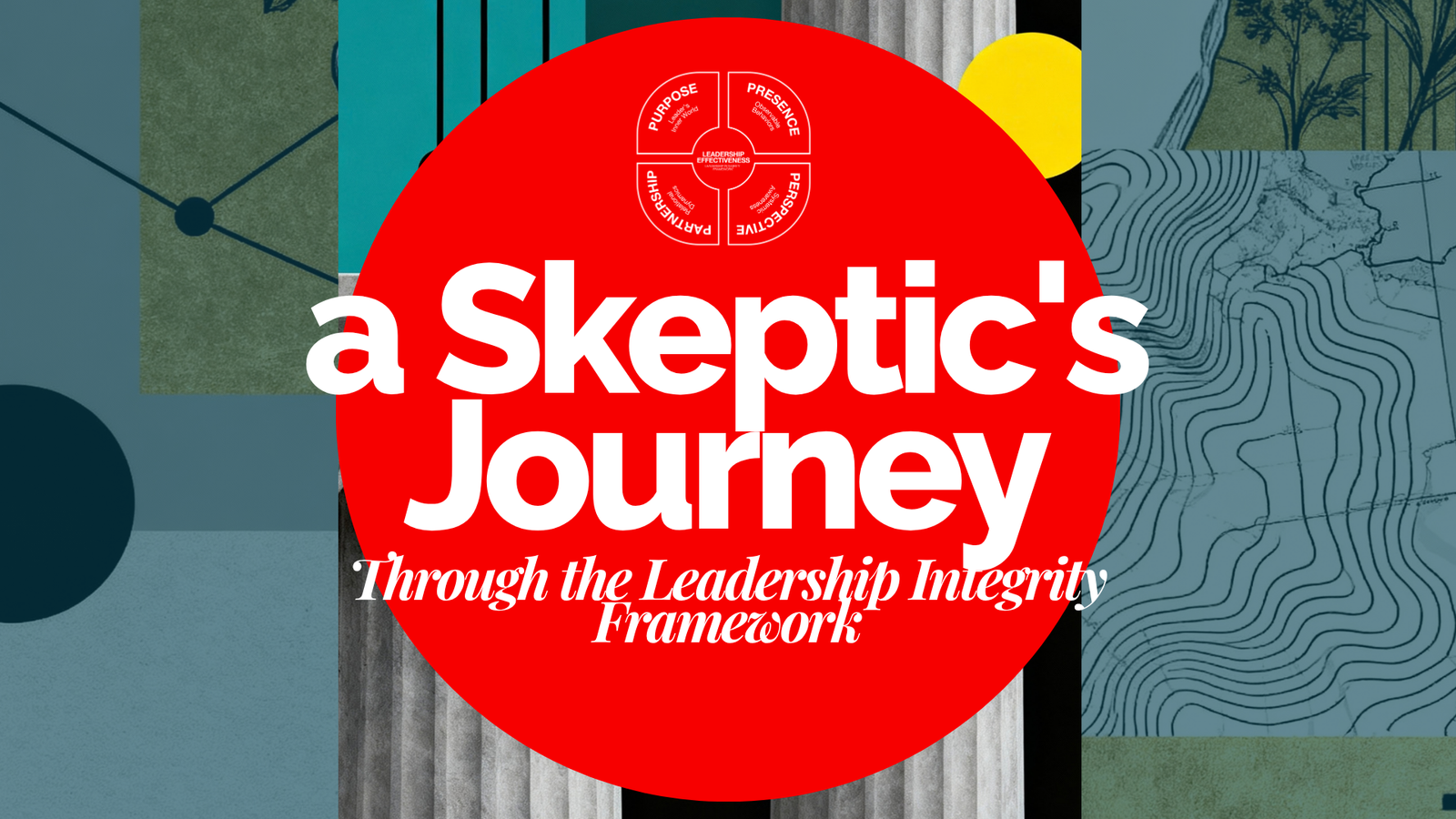
That’s how I came across the Leadership Integrity Framework. I thought it would be just part of a small research project, and that I’d do what I always do: read, synthesize, write, and move on.

By then, I’d read my way through a small library of leadership thinking. Competency models taught me what effective leaders do. Emotional intelligence reminded me that leadership is deeply human. Systems thinking helped me see patterns rather than isolated problems. Developmental theories shifted my attention from what leaders know to how they make sense of complexity.

Even more integrative approaches, like Ken Wilber’s Integral Theory, tried to bring those perspectives together. I admired the ambition. At the same time, I wondered what those ideas looked like in an ordinary leadership conversation on an ordinary Tuesday morning.

And that was the one thing all these ideas had in common. It was difficult to see them in action when you’re sitting across from a client making tough decisions or trying to lead through uncertainty.

When curiosity met skepticism

Reading about the Leadership Integrity Framework at first, I had extremely contradicting feelings. On the one hand, I had to admit it looked at leadership in a way no other model I’d studied did. It emphasized what each dimension would look like in practice. And it looked at the individual from all points of view, instead of narrowly focusing on just a handful of qualities.

But I also resisted it. For instance, I couldn’t understand why we needed four dimensions. Purpose, for instance, almost sounded like another value exercise, where you talk a lot, make lists, and in the end, change little in your behavior; what didn’t work before stays largely the same.

Partnership felt obvious, while Perspective sounded a lot like systems thinking. But I’m curious, a researcher by nature—after all, I did obtain a PhD in what feels like another lifetime—so I stuck with it. I tried to learn more, read the book, talked to Maria, and carefully checked all the case studies.

If you’re expecting the lightbulb moment, you’ll be disappointed. I didn’t suddenly understand how wrong I’d been in my interpretation of the framework or my doubts about its four dimensions. That was extremely gradual and almost imperceptible. The first visible changes came precisely in my work.

When the framework escaped the page

It started, of all places, in an email I almost sent without thinking twice.

A client had asked me to ghostwrite her LinkedIn posts for the next quarter. It was a straightforward brief, the kind I get every week: find her voice, keep the posts consistent, make her sound as sharp on the page as she is in a room.

I sat down to draft the first few, and then stopped, half a post in, because I realized I didn’t actually know what she wanted her network to believe about her, only what topics she wanted to be seen posting about.

Something I’d read in the Leadership Integrity Framework suddenly came to mind, even though it hadn’t been on my mind for a while. That was a Purpose question.

The idea just showed up, the way a word you learned last week suddenly appears in every conversation you have. So I asked her plainly: “What do you actually want people to walk away believing about you, three months from now, after reading a dozen of these posts?”

Her first instinct was to reiterate the topics she wanted to cover. But I needed to understand the belief underneath them, the real her, as she needed to appear in front of her audience.

Her answer changed the whole content plan. It also took twenty extra minutes I hadn’t billed for, and for a second I resented the framework a little for that.

I couldn’t help but remember how I’d initially thought that Purpose sounded like a values exercise that changes nothing. Here it was, reshaping a client’s entire posting strategy.

The dimension I didn’t expect to need

After that first experience seeing the framework in practice in such an unexpected context, I became more observant.

Partnership was the one dimension I thought I already understood. I’ve run a freelance business for over a decade; I know how to be pleasant, responsive, and easy to work with. What I hadn’t fully clocked is the difference between being easy to work with and being honest with someone.

A few years ago, as I was meeting with a long-term client, he casually changed the scope of our project. It was the sixth time this had happened. Yes, it is completely normal to have scope changes, especially in long-term projects where priorities and needs may evolve. But I couldn’t help but feel we had entered an era of constant adjustments..

I didn’t want to lose him as a client. I loved his project and, up until that point, we had gotten along great. But I knew I had to say something, no matter how uncomfortable it felt.

I dislike confrontation, and even though this moment wasn’t a confrontation in the real sense of the word, I sometimes feel it’s easier to smooth things out rather than to name them. Professional boundaries? Sure, but this situation required a little more than that.

It required Partnership. This dimension, contrary to what you may think at first glance, has little to do with being agreeable. It’s more about continuing a professional relationship even when you have to say hard things. I’d read that sentence a dozen times in the book, but I only understood it once I had to put it into practice.

Where Perspective actually lives

Perspective was the dimension I was most suspicious of, because it sounded like systems thinking with a rebrand. And I’d studied systems thinking in-depth. I did not need another name for it.

But did I actually use its principles myself? As it turned out, I rarely did. I’m good at mapping a client’s ecosystem—their audience, their competitors, their internal politics—when I’m working on their behalf. I was much worse at zooming out on my own business.

Not too long ago, I found myself in a peculiar spot. My business was going well, but I was taking on more last-minute projects that I normally liked. Once or twice, that’s okay, but it was becoming almost a habit and it was more and more challenging.

So I decided to take a step back and look at what was happening. Had I been unlucky and signed a few problematic clients that would forever come up with last-minute requests? Was something wrong with the projects themselves? Or was there another problem entirely?

In situations like these, it’s easy to point the blame. But then I remembered the Perspective dimension and took a broader look at all these projects. And I finally saw it. All these rush projects were coming from clients I had under-scoped at intake.

That’s the piece that surprised me most, honestly. I’d assumed Perspective was the “expert” dimension, the one for people managing large teams or complex organizations. It turned out to be just as useful pointed inward, at a business of one.

Presence, or how I learned to notice the gap

If Purpose is what I mean, and Perspective is what I see, Presence is what has actual impact. From the start, this was the dimension that hit closest to home, even though I’m not the chief executive of a corporation.

I may not have a large team that answers to me, but Presence shows up the most during those first discovery calls, when a client decides whether they can trust the person in front of them enough to hand over something unfinished or half-formed. Or during the next conversations, when we set up crucial projects for their business.

For a long time, I thought that was all about charisma. But then I read the framework, and it gave me a better question: What’s the gap between what I want to communicate and what the other person understands?

A few years ago, while I was still perfecting my offer and my style, a prospect emailed me to tell me they wouldn’t be moving forward with our collaboration. In my mind, we’d had a great discovery call, and I’d sent them a fantastic offer. I decided to politely ask why. I honestly didn’t expect an answer, and I knew they didn’t owe me an explanation.

But to my surprise, the answer came, and it had nothing to do with what I knew or didn’t know or with the price. “Your tone sounded really cold. As if you really disliked us. And your questions were always so abrupt, almost interrupting me.”

In my mind, the tone I’d used was polite and professional. The questions? They were there to clarify the scope and to help them see I knew what I was doing and that I already saw a potential direction for their project. They had somehow read it as disinterest and impoliteness.

Some might say they were too sensitive, and that’s always a possibility. But looking back on it now, especially after learning about the framework, I can say for a fact my Presence was far from ideal.

Since then, I’ve been trying to give the other person more space to talk and to express themselves. Small adjustment. Large difference in how relationships start.

None of these dimensions did much on their own. Purpose without an honest Partnership conversation would have stayed a nice idea I never acted on. Perspective without Presence would have remained a private realization I never brought into a client relationship.

The four together are what actually made a difference, and that’s probably the most researcher-brained conclusion I can offer: the interaction effect matters more than any single variable.

I still don’t have a lightbulb moment to offer. What I have instead is a body of small, specific decisions, ghostwriting questions, a hard conversation, a business decision I made differently, that only make sense in hindsight as one coherent shift.

I came to this framework as a skeptic with a stack of other models already in my head. I’m leaving it, for now, as someone who uses it quietly, in the background, on an ordinary Tuesday morning, the exact place I once doubted any of this could live.

Take the Next Step

Discover Your Leadership Signature

Not sure where to start? The LīF Assessment helps you identify which dimension is your natural strength right now.

Explore the Leadership Integrity Framework

Want to understand the four dimensions before you dive into the book? Start with the framework overview.

Join the MARIA WADE | FOR INTEGRITY community

Stay in the loop as I share new projects, releases, and reflections on leadership and coaching regularly, but not too often. Choose what describes you best so I can send you only what’s most relevant. You can update your preferences or unsubscribe anytime.